
Online Notarization in Ontario: What Can Be Done Online and What Cannot

Many websites advertise online or virtual notarization services without clearly explaining what can actually be done remotely, what requires an in-person appointment, and what the receiving organization will accept.
The distinction is important.
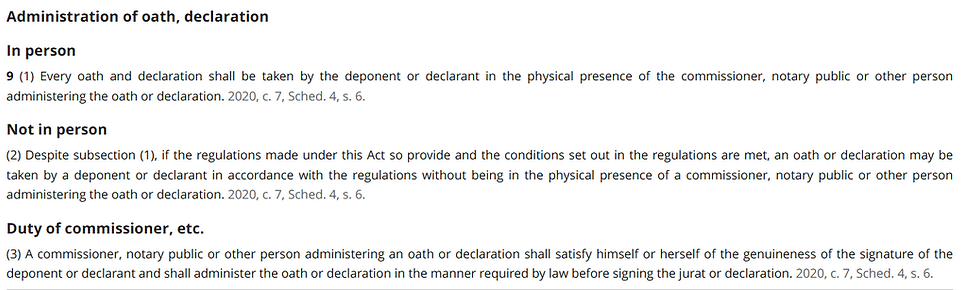
In Ontario, certain oaths and declarations can be administered remotely by videoconference, provided the requirements of Ontario’s remote-commissioning rules are followed. This is because under the Commissioners for Taking Affidavits Act, R.S.O. 1990, c. C.17, remote commissioning is allowed. This does not mean that every notarial service can be completed online.
In particular, certified true copies cannot simply be completed online by looking at a scanned copy or photograph of the original document. If you need a document certified as a true copy of the original, you will generally need to bring the original document to a notary public for in-person inspection.
So, what can be done online and what should be done in person?
Commissioning and Notarization Are Not the Same Thing
The terms “commissioning” and “notarization” are often used interchangeably, but they describe different services. A commissioner for taking affidavits generally administers oaths and takes affidavits, declarations and affirmations.
A notary may perform commissioner functions, but may also provide notarial services such as certifying copies of documents and witnessing or authenticating signatures and documents, depending on the circumstances and the requirements of the receiving organization.
This distinction matters because a document that only needs to be sworn or declared may be capable of being completed remotely, while a document that requires a true-copy certification or another notarial act may require an in-person appointment.
What Can Be Done Online in Ontario?
Ontario permits certain affidavits, statutory declarations and other oaths or declarations to be administered remotely.
Under Ontario Regulation 431/20, the participants must be able to see, hear and communicate with each other in real time, the person administering the oath or declaration must confirm the person's identity, and the document must contain a modified jurat or declaration indicating that it was administered remotely and identifying the relevant locations. There are also record-keeping and other requirements.
For example, depending on the requirements of the document and the organization receiving it, a client may be able to complete a:
Statutory declaration
Affidavit
Sworn statement
Declaration or affirmation
without physically attending the notary or commissioner’s office.
This can be particularly useful when a client is located in another city or is unable to attend in person.
However, there is an important qualification:
The fact that a document can legally be commissioned remotely does not necessarily mean that the organization receiving it must accept it.
The Ontario government's own guidance specifically notes that a receiving organization is not required to accept a remotely commissioned document. Clients should therefore confirm the requirements of the organization receiving the document before choosing remote commissioning.
What Cannot Be Done Online?
This is where much of the confusion occurs.
Certified True Copies
One of the most common misconceptions is that a notary can certify a document as a true copy simply by having the client upload a scan or photograph of the original.
We do not provide certified true copies online.
When a client asks for a certified true copy, the notary needs to examine the original document and compare it with the copy being certified.
For example, if you need a certified true copy of:
A passport
Birth certificate
Marriage certificate
Degree or diploma
Government-issued document
Will
Power of Attorney
Corporate document
Other original document
you should bring the original document to the notary.
A photograph, scan, PDF or photocopy of the document does not allow us to independently inspect the original. This is one of the clearest examples of why “online notarization” can be misleading. An online service may be able to verify your identity and administer an oath remotely, but that does not turn a scanned document into an original document that a notary can certify as a true copy.
Other Services May Also Require an In-Person Appointment
Whether a document can be handled remotely depends not only on Ontario law, but also on what the document is and what the receiving organization requires.
In-person service may be necessary or strongly recommended for matters such as:
Certified true copies
Documents where the original must be physically inspected
Certain signature-witnessing requirements
Wills and Powers of Attorney
Documents being submitted to foreign authorities
Documents where the receiving organization specifically requires an original notarized document
Situations where the receiving organization will not accept a remotely commissioned document
For documents going outside Canada, this distinction can be especially important. A foreign government, embassy, bank, lawyer or other institution may have its own requirements concerning notarization, original documents, signatures, seals and authentication.
A document being legally capable of remote commissioning in Ontario does not automatically mean that the receiving country or institution will accept it.
Online Commissioning vs. In-Person Notarization
At Affordable Markham Notary Public, we have experience with both remote commissioning and traditional in-person notarization.
Remote commissioning can certainly be useful. It allows people to complete eligible affidavits and declarations without travelling to an office, and it can be particularly convenient when distance or scheduling is an issue.
Why We Are Careful About the Term “Online Notarization”
The phrase “online notarization” makes it sound as though every service a notary provides in person can simply be transferred to a video call.
That is not how it works.
Ontario's remote-commissioning rules specifically permit certain oaths and declarations to be administered remotely. They do not mean that every document can be notarized online or that every receiving organization will accept a remotely completed document.
That is why we prefer to explain exactly what service is being provided rather than simply calling everything “online notarization.”
A Simple Rule of Thumb
If your document simply needs to be sworn, affirmed or declared, remote commissioning may be an option.
If your document needs an original document to be physically inspected, a certified true copy, or another service that requires in-person handling, you should expect to attend in person.
And if you are unsure, ask before completing the document.
The requirements of the organization receiving your document are just as important as the process used to sign or notarize it.
The Bottom Line
Remote commissioning is a legitimate and useful option in Ontario for eligible affidavits, statutory declarations and other oaths or declarations.
But remote commissioning is not a substitute for every notarial service.
For many routine documents, in-person service is also simpler, faster and more reliable. You can bring your documents and identification to our office, have the documents reviewed and completed, and leave with everything properly signed, commissioned, notarized or certified.
When it comes to notarization, the goal is not simply to complete a document online.
The goal is to make sure the document is completed correctly and that it will actually be accepted where you need to use it.
As always, you are welcome to walk-in to our office at 3636 Steeles Avenue East, Unit 312, Markham ON L3R 1K9, or book and appointment online today!


Comments